
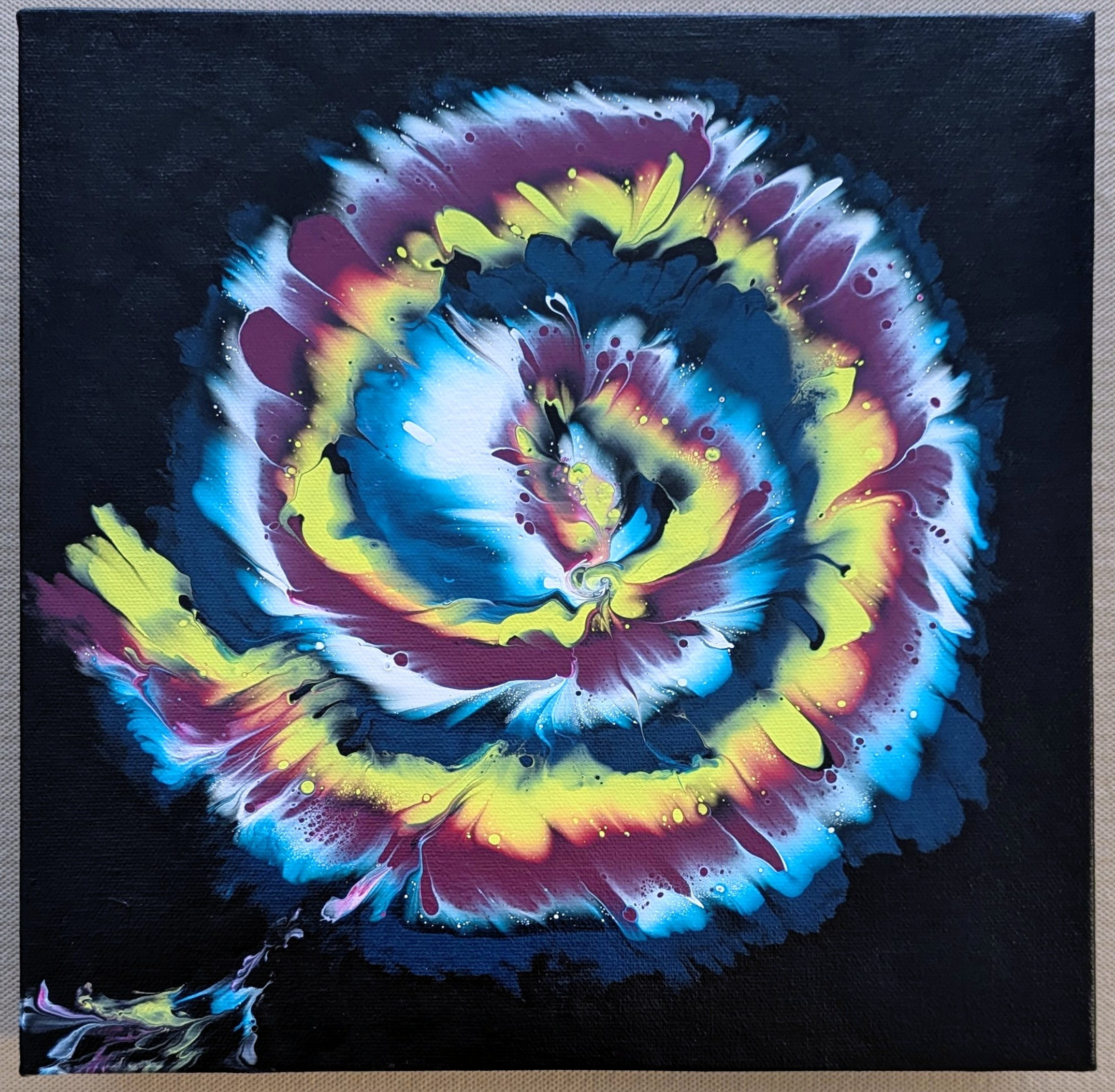
I watch a lot of fluid art tutorials—and by a lot, I really do mean *a lot*. I observe, I take notes, and I quietly plan. I notice what I want to try exactly the same, and what I might gently change. There is something comforting about watching someone who knows their craft so well, moving with confidence and ease.
One artist I return to often is Fiona from Slovenia. That’s how she always introduces herself, and there’s something about it that feels warm and grounding. Her work is beautiful, and the way she approaches it feels calm and intentional. One of her techniques involves draping a wet napkin over a paint-covered canvas and slowly lifting it away to reveal a flower. I’ve watched her do this many times. Eventually, curiosity won out and I decided it was time to try it myself.
As is often the case, what looks effortless when someone else does it feels very different when your own hands are involved.
Because this was my first attempt, I stayed close to what I had seen: a similar canvas size, a similar palette, a similar setup. I sprayed the napkin with water and laid the first half onto the canvas. The next step was to gently stretch the remaining half across the surface. Simple in theory. In practice, the napkin was far wetter than I realized, and it dipped into the paint before I was ready. I paused, noticed what had happened, and thought, *well… there’s Beautiful Oops #1.*
I lifted the napkin and tried again, knowing the original pattern was already changed. Then came the careful lifting process—diagonal corners first, then working inward. Except my napkin, still too wet, had other plans. It clumped together instead of lifting cleanly. I couldn’t help but laugh. And there it is, I thought. *Beautiful Oops #2.*
When the napkin finally came away, the result looked nothing like the flower I had imagined. Instead, I saw something else entirely, something that reminded me of a dreamcatcher. I gave the canvas a few gentle spins, just enough to let the paint stretch and breathe, and I smiled. This wasn’t what I had planned, but it was interesting. It had movement. It had its own quiet presence.
So I let go of the original intention. I trusted the process as it unfolded instead of how I had hoped it would unfold. I went with the flow, embraced the missteps, and found myself pleasantly surprised by where I landed.
That doesn’t always happen. Sometimes a painting truly doesn’t work and starting over is the right choice. But even then, something is learned. And sometimes—when you least expect it—you’re reminded that not following the plan doesn’t mean you’ve failed.
I’m determined to try this method again until I finally coax a flower out of it. But I wanted to document the attempts that don’t quite get there. The imperfect ones. The learning ones. I think it’s just as important to share the trial and error, the patience it takes, and the willingness to keep going when something turns out differently than imagined.
I often wonder how many times Fiona tried before this technique felt natural in her hands.
Until next time, I hope you allow room for a beautiful oops of your own.
Title: Dream-catcher
Size: 30×30 cm