
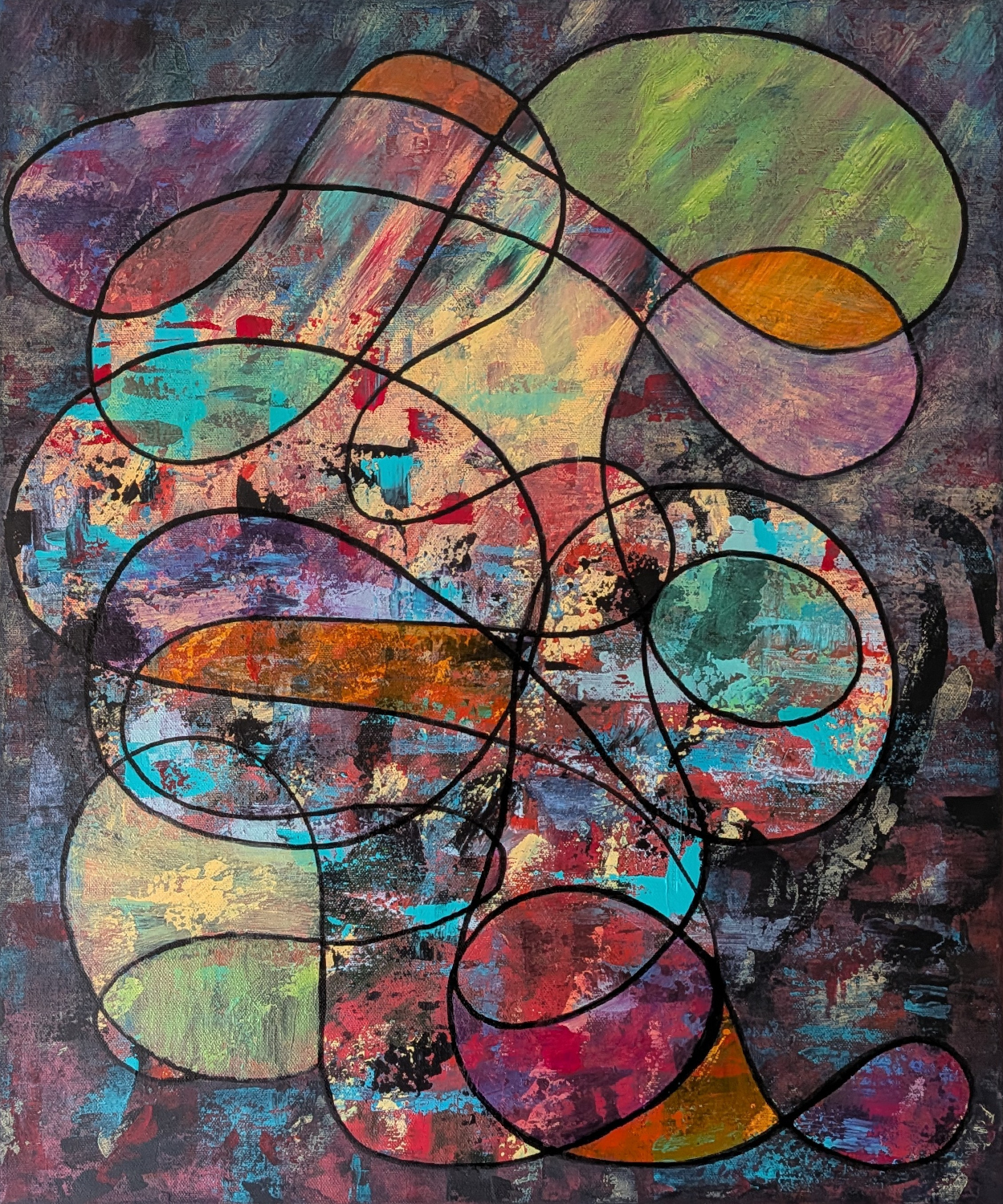
Circuitous
 The best path forward is rarely the straight one.
30 August 2026
While deciding what to paint next, I found myself staring at a beloved painting in our living room. It was given to us as a wedding present by my friend Thiago, who painted it himself and traveled all the way from Norway to California to give it to us on our wedding day.
Twelve years later, it still hangs proudly on our living room wall in Sweden and makes me smile every time I see it.
I love its colors so much that I decided to paint a companion piece. While it was taking shape, I called it Thiago’s Sister, knowing I would find its real name once I completed it.
The painting began with the same beautiful creams, reds, and blues that I loved in Thiago’s painting. And then, I decided to take a left turn. I picked up brushes, started scraping, and followed whatever seemed interesting at the time. There were parts I liked, colors I loved, and plenty of interesting little moments. But as a whole, something wasn’t working for me.
So I kept going.
When I thought I couldn’t take it further with paint, I stared at it for days before deciding to take a black paint pen and draw a single swirling line across the entire canvas.
I didn’t plan where it would go. And once I started, I didn’t lift the pen from the canvas.
The line wandered. It looped around itself, crossed over places it had already been, traveled from one side of the painting to another, doubled back, and created shapes I hadn’t intended. Eventually I stopped, looked at what I had done, and realized I liked the painting more.
That single wandering line somehow brought together a background that had previously felt disconnected. It gave my eye something to follow through all of the color and texture.
And, more importantly, it gave me another idea.
The overlapping line had divided the painting into dozens of irregular shapes. What would happen if I treated some of them almost like pieces of stained glass?
I began selectively glazing individual sections, allowing the original painting to remain visible underneath. Teal came first, followed by red and warm yellow. Later I added purple, green, and orange. Some areas became bold and obvious. Others remained subtle. And many of the shapes I left completely alone. Slowly, another version of the painting emerged.
But I still wasn’t quite finished.
I liked the stained-glass feeling that was beginning to emerge, but I wondered if I could push it a little further without adding anything more to the shapes themselves. Instead, I went in the opposite direction. I mixed a transparent wash of Payne’s Grey and Cobalt Blue and began slowly darkening the areas outside the wandering line.
I built it up gradually, one thin layer at a time, making sure the colors and texture underneath were still visible. As the surrounding areas became quieter, the shapes inside the line began to come forward. The colors felt brighter, the line became more purposeful, and the stained-glass quality I had stumbled upon became a little more pronounced.
Sometimes changing what surrounds something changes the way you see it.
When my husband first saw the finished line, before I had added any of the colored glazes, he asked if it represented my life. 🤣 It didn’t. At least, not consciously.
But the more I thought about it, the more I wondered if perhaps my hand knew something my brain hadn’t figured out yet.
Of course, what I see isn’t necessarily what anyone else sees.
My son looked at the finished painting and immediately found characters hiding among the lines and colors. On the right, he saw a face with a big blue nose, two black eyes, and a huge smile. On the lower left, the green and yellow shapes became a ghost.
That is one of the things I love most about abstract art. I can make the marks, choose the colors, and follow whatever instinct is pulling me forward, but once someone else stands in front of the painting, it becomes partly theirs. They bring their own experiences, imagination, and way of seeing.
Apparently, in our house, that means one person sees the journey of a life while another finds a smiling blue-nosed face and a ghost. 🤣
I rather love that.
What I find interesting now is that the process of making Circuitous feels strangely connected to the line itself.
There was no direct route from where this painting began to where it ended.
I tried something. Changed something. Followed an idea. Doubled back. Took another direction. Discovered something unexpected and followed that instead.
It was circuitous.
I’ve been trying to give myself more permission lately to work this way. Instead of assuming that every painting needs to follow a clear plan, or that I need to protect something simply because it is “good enough,” I’ve been pushing myself to experiment. I want to see what happens when I’m less afraid of ruining something and more curious about what else it could become.
There are endless ways a painting can go, and perhaps just as many ways it can be seen.
Another artist could have taken this same canvas in an entirely different direction. I could have taken it in a hundred different directions myself. That is the part I am trying to remember.
There isn’t always one correct next move.
Sometimes you make a mark and see where it takes you.
Then another.
And another.
Until somewhere along the way, you arrive.
Maybe not where you expected.
But somewhere you couldn’t have reached by taking the straight path.
Circuitous 60 × 50 cm